
- About
- Services
- Translation
- Transcription
- Subtitling
- Interpretation
- Languages
- Blog
- Contact Us
- Request a Quote

Certified vs Notarized Translation: What Authorities Actually Accept
December 22, 2025
info@ananenterprises.com
Introduction
International applications for visas, education, and legal processes are increasingly strict. Courts, immigration offices, universities, and embassies demand accurate, certified translations.
Yet many applicants mistakenly rely on notarized translations or treat certification and notarization as the same. This guide will clear up the confusion, explain what authorities require, and help you avoid costly setbacks.
The Cost of Getting It Wrong: Why This Confusion Leads to Rejections
When documents cross borders, accuracy is no longer a preference—it’s a legal requirement.
Authorities don’t review translated documents casually. They check for:
- Accuracy
- Completeness
- Accountability
- Compliance with formal standards
Submitting the wrong type of translation can result in:
- Application holds
- Rejection notices
- Requests for resubmission
- Missed deadlines
- Added costs and delays
And most of these outcomes are completely avoidable.
What a Certified Translation Actually Is
Certified translation means your document is completely and accurately translated, with a signed certification from a professional translator or translation agency.
This certification confirms that:
- The translation is complete
- The translation is accurate
- The content faithfully represents the original document
- The translator is qualified to perform the work
This signed statement is what gives the document legal credibility.
What a Certification Statement Includes?
A valid certification statement typically contains:
- Translator’s name and signature
- Confirmation of accuracy and completeness
- Date of certification
- Contact details of the translator or agency
This statement makes the translation accountable, which is exactly what authorities require.
Why Authorities Require Certified Translations
Certified translations provide:
- Standardized review formats
- Legal accountability
- Consistent decision-making
- Reduced risk of misinterpretation
In short, certified translations make it easier for institutions to trust what they’re reading.
What a Notarized Translation Actually Means
A notarized translation is a translation that has been signed in the presence of a notary public. The notary verifies the identity of the signer, not the quality of the translation.
This distinction matters.
What Notarization Does NOT Do
Notarization:
- Does not confirm translation accuracy
- Does not validate language quality
- Does not guarantee institutional acceptance
- Does not replace certification
A notary public is not responsible for checking whether the translation is correct.
Why Notarization Is So Often Misunderstood
The confusion comes from association. Notarization is commonly linked with official documents, so applicants assume it adds authority to translations. In reality, notarization is often supplementary, not sufficient.
Certified vs Notarized Translation: The Differences That Actually Matter
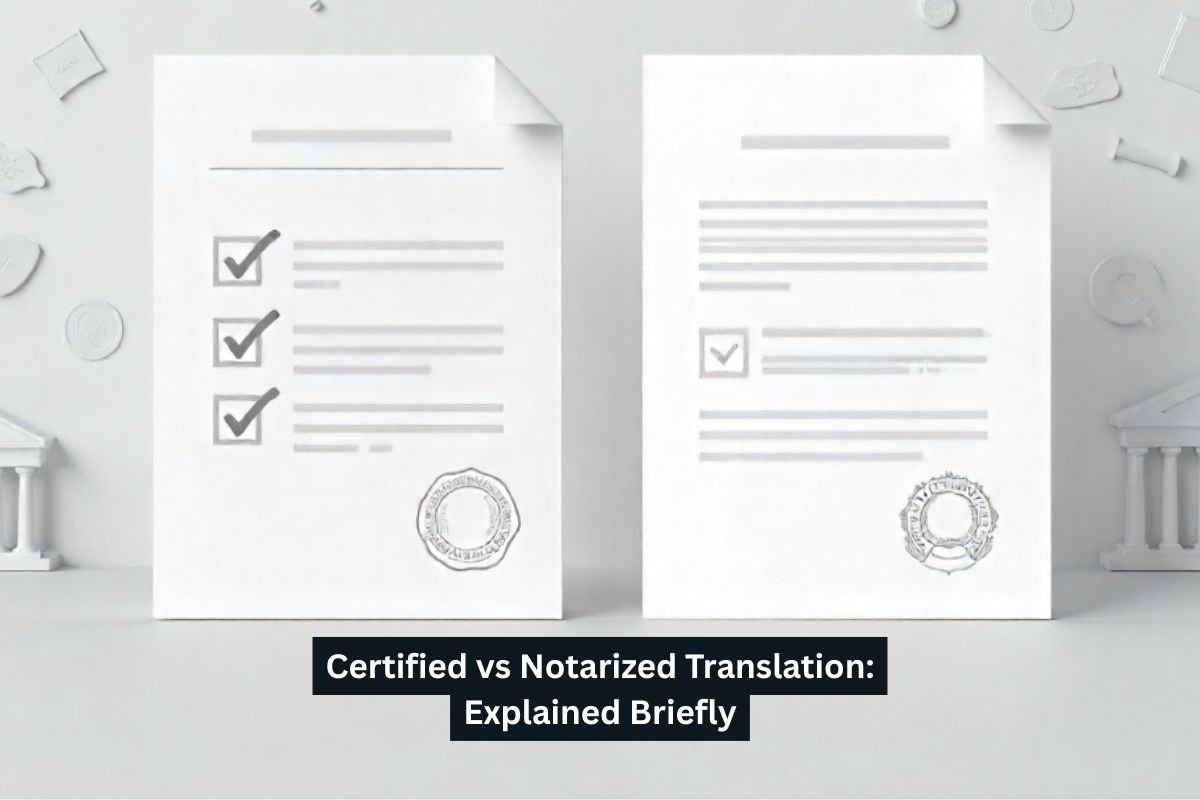
Side-by-Side Comparison
| Criterion | Certified Translation | Notarized Translation |
|---|---|---|
| Confirms accuracy | ✅ Yes | ❌ No |
| Includes certification statement | ✅ Yes | ❌ No |
| Verifies signer identity | ❌ No | ✅ Yes |
| Accepted by authorities | ✅ Yes | ❌ Not always |
| Required for immigration | ✅ Yes | ❌ No |
| Legal accountability | ✅ Yes | ❌ Limited |
Outcome-Based Reality Check
- Certified translation → Higher acceptance, fewer delays
- Notarized only → Higher rejection risk
If accuracy and acceptance matter, certification is non-negotiable.
What Authorities Actually Require (By Use Case)
Immigration Authorities
Immigration departments rely heavily on certified translations to verify:
- Identity
- Eligibility
- Legal history
Common documents requiring certified translation:
- Birth certificates
- Marriage certificates
- Passports
- Police clearance certificates
- Affidavits
- Court orders
Uncertified or improperly notarized translations often trigger:
- Application holds
- Requests for resubmission
- Rejections
Courts and Legal Bodies
Courts require documents that retain legal meaning across languages.
Certified translations are mandatory for:
- Court judgments
- Pleadings
- Contracts
- Powers of attorney
- Arbitration documents
Notarization may be required in addition, but never as a replacement.
Universities and Credential Evaluation Agencies
Academic institutions require certified translations to evaluate qualifications fairly.
Documents include:
- Degree certificates
- Transcripts
- Diplomas
- Mark sheets
Uncertified translations raise credibility concerns and often lead to rejection.
Embassies and Consulates
Embassies typically require:
- Certified translations
- Plus apostille or attestation (depending on the country)
Notarization alone rarely meets embassy standards.
Real-World Rejection Scenarios (And Why They Happen)
Many rejections stem from simple, avoidable mistakes:
- Missing certification statement
- Only notarized, not certified
- Partial translations
- Formatting inconsistencies
- Use of non-qualified translators
- Mismatch between original and translated documents
These errors highlight one truth: translation quality directly affects outcomes.
When Do You Need Both Certified and Notarized Translation?
In some cases, both may be required—but they serve different purposes.
Examples:
- Cross-border affidavits
- Power of attorney documents
- Country-specific legal filings
Rule of thumb:
- Certification ensures accuracy
- Notarization verifies identity
They are complementary, not interchangeable.
Certified Translation in India vs International Submissions
Requirements vary by destination.
Common scenarios:
- India → Abroad: Certified translation + apostille
- US / UK / Canada: Certified translation mandatory
- EU: Certified translation + country-specific validation
Understanding destination-specific requirements prevents resubmissions.
Quick Decision Checklist
Choose Certified Translation If:
- Submitting to immigration authorities
- Filing court documents
- Applying to universities
- Submitting to embassies
Add Notarization Only If:
- Explicitly requested by the authority.
If unsure, always default to certified translation first.
Why Translation Quality Directly Shapes Outcomes
Poor translation doesn’t just slow things down—it creates risk.
Consequences include:
- Processing delays
- Application rejection
- Legal exposure
- Additional costs
Accuracy isn’t optional when institutions review documents.
How Anan Translations Ensures Institutional Acceptance
Anan Translations provides certified translation services built for compliance and acceptance.
What sets us apart:
- Certified translations by qualified professionals
- Multi-step quality checks
- Support for notarization, apostille, and attestation
- Secure handling of sensitive documents
- Coverage in 400+ languages
We don’t just translate documents—we ensure they’re accepted.
Final Takeaway: Accuracy Is a Requirement, Not an Upgrade
Certified translations turn uncertainty into acceptance.
If your documents are being reviewed by courts, universities, or government agencies, certification is essential.
Don’t risk rejection, opt for certified translation.
FAQs
Is notarized translation enough for immigration?
Do courts accept notarized translations?
Who can certify a translation?
Do universities accept notarized documents?
How fast can certified translations be completed?
Need Certified Translation That Authorities Accept?
Avoid rejections and delays. Get certified translations accepted by immigration offices, courts, universities, and authorities worldwide.