
- About
- Services
- Translation
- Transcription
- Subtitling
- Interpretation
- Languages
- Blog
- Contact Us
- Request a Quote

Market Research Translation for Pharmaceutical Clinical Surveys: Accuracy That Protects Data, Patients & Regulatory Approval
February 26, 2026
info@ananenterprises.com
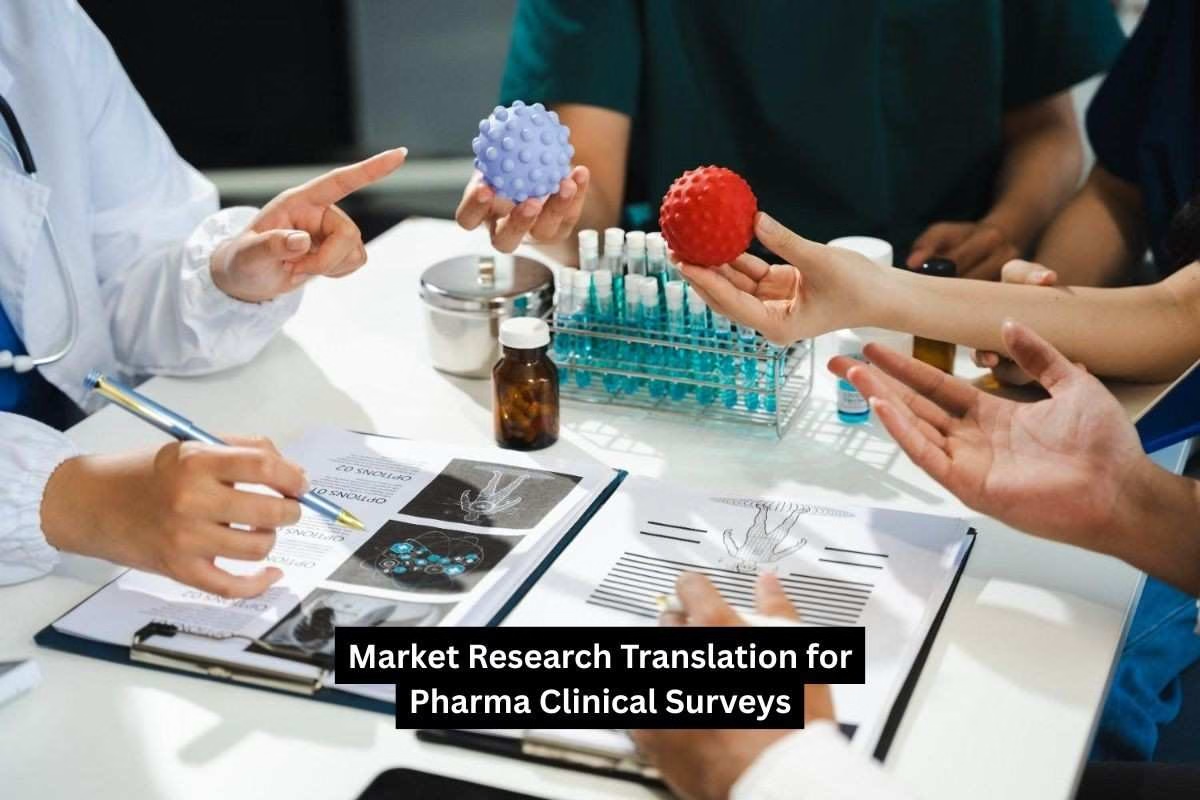
In pharmaceutical research, one mistranslated word can distort an entire dataset.
Clinical surveys are not casual questionnaires. They influence regulatory decisions, shape perceptions of drug safety, validate patient-reported outcomes, and inform multi-million-dollar market strategies. For international trials, market research translation safeguards data accuracy, beyond simple language conversion.
This guide explains why pharmaceutical clinical survey translation demands precision, what regulatory authorities expect, how linguistic validation works, and how to protect the integrity of global clinical data.
Why Clinical Survey Translation Is High-Stakes
Pharmaceutical companies invest years and billions of dollars in clinical trials. Market research surveys — from pre-trial to post-marketing — gather critical data from patients, investigators, and healthcare professionals.
If that data is linguistically flawed, the consequences include:
- Skewed patient-reported outcomes (PROs)
- Inconsistent symptom reporting
- Cultural bias in response scales
- Regulatory pushback or rejection
- Trial delays and financial losses
- Compromised patient safety
Authorities such as the U.S. Food and Drug Administration and the European Medicines Agency require reliable, reproducible, and culturally appropriate patient data. Inaccurate translation threatens that reliability.
Clinical research is data-driven. And data is only as strong as the language used to collect it.
What Is Pharmaceutical Market Research Translation?
Pharmaceutical market research translation refers to the specialized translation and localization of surveys, questionnaires, and research instruments used in clinical and post-clinical research.
It differs from standard medical translation in several ways:
- It focuses on patient responses and perception-based data
- It requires cross-cultural adaptation
- It often involves linguistic validation
- It must maintain statistical comparability across languages
It Covers:
- Patient-reported outcome measures (PROMs)
- Quality of Life (QoL) surveys
- Pharmacovigilance feedback forms
- Adverse event reporting questionnaires
- Post-marketing surveillance surveys
- Investigator and healthcare provider feedback forms
Unlike translating a medical report, survey translation must preserve:
- Meaning
- Intent
- Emotional tone
- Response scale equivalency
- Cultural neutrality
How Poor Translation Corrupts Clinical Data
A literal translation is not enough. Even small linguistic errors can significantly distort research findings.
For biotechnology applications:
- Sequence listings must comply with CNIPA formatting rules.
- Amino acid and nucleotide terminology must follow international standards.
Improper formatting may delay acceptance.
Example:
In some languages, the word “discomfort” may be translated more closely as “pain.” That subtle shift can inflate reported severity scores and affect trial outcome analysis.
The result?
Bad translation → Bad data → Bad decisions.
Types of Clinical Surveys That Require Expert Translation
Pharmaceutical research relies on various structured instruments. Each requires expert handling.
1. Patient-Reported Outcome Measures (PROMs)
Used to capture patients’ perspectives on symptoms, treatment effectiveness, and side effects.
2. Quality of Life (QoL) Questionnaires
Assess how treatment impacts daily life, mental health, and functionality.
3. Pharmacovigilance Surveys
Collect safety data post-drug approval.
4. Adverse Event Reporting Forms
Require precise medical terminology and unambiguous phrasing.
5. Investigator Feedback Surveys
Gather clinician observations during trials.
Each of these tools must maintain equivalence across languages to allow valid cross-country comparison.
The Gold Standard: Clinical Survey Translation Process
High-quality pharmaceutical market research translation follows a structured, multi-step methodology.
Step 1: Terminology Research & Glossary Creation
- Review medical terminology
- Align with sponsor-provided glossaries
- Ensure consistency with prior studies
Step 2: Forward Translation
Two independent medical linguists translate the survey into the target language.
Step 3: Reconciliation
A senior reviewer compares both translations and creates a unified version.
Step 4: Back Translation
The translated version is returned to the original language by a separate linguist to identify discrepancies.
Step 5: Cognitive Debriefing
Native-speaking patients test the translated survey to ensure clarity and cultural relevance.
Step 6: Final Review & Validation Report
A comprehensive report documents every linguistic decision — often required by regulators.
Organizations like the World Health Organization and regulatory bodies emphasize structured linguistic validation for multinational trials.
Linguistic Validation vs Standard Translation
Many pharmaceutical companies misunderstand this distinction.
Standard Translation:
- Converts text from one language to another
- Focuses on accuracy
Linguistic Validation:
- Ensures conceptual equivalence
- Confirms cultural relevance
- Includes patient testing
- Produces formal documentation
For multinational trials submitted to the U.S. Food and Drug Administration or the European Medicines Agency, linguistic validation is often expected.
Without validation, the comparability of survey data may be questioned.
Cultural Nuances: Why Literal Translation Fails
Language is shaped by culture.
Certain conditions, symptoms, or mental health concepts may not translate directly across regions.
Examples of Cultural Challenges:
- Stigma around mental health reporting
- Different pain tolerance expressions
- Variations in describing fatigue
- Literacy-level differences
- Formal vs informal language expectations
Even response styles differ. Some cultures avoid extreme answers on rating scales, while others prefer them.
If surveys are not adapted culturally, statistical results become unreliable.
Regulatory Compliance & Documentation
Pharmaceutical companies must align survey translation processes with international standards.
Key Regulatory Considerations:
- Documentation trail for each version
- Version control tracking
- Audit-ready linguistic validation reports
- Proof of qualified medical translators
- Secure data handling practices
In India, compliance with the Central Drugs Standard Control Organization is essential for local trials.
In Europe, multilingual submissions must meet standards recognized by the European Medicines Agency.
Failure to meet documentation standards can delay approvals.
AI vs Human Translation in Pharmaceutical Research
Artificial intelligence is transforming translation workflows. But clinical survey translation remains high risk.
Where AI Helps:
- Draft translation generation
- Terminology extraction
- Speed for internal reviews
Where AI Fails:
- Context-sensitive medical nuance
- Cultural adaptation
- Regulatory compliance documentation
- Cognitive debriefing
- Ethical interpretation of patient language
In pharmaceutical research, a hybrid model works best — AI-assisted workflows combined with expert medical linguists.
Data Security & Confidentiality
Clinical research involves sensitive patient data and proprietary drug information.
Translation providers must ensure:
- NDA agreements
- Encrypted file transfer
- Restricted-access systems
- Compliance with the General Data Protection Regulation
- HIPAA-aligned processes for US-based trials
Data breaches not only violate privacy laws but can destroy patient trust.
The financial impact of translation errors in pharmaceutical research is enormous.
FAQs
What is linguistic validation in clinical trials?
It is a structured process ensuring that translated surveys maintain conceptual equivalence and cultural accuracy across languages, including patient testing and documentation.
Is back translation mandatory?
Now compare that to the cost of professional linguistic validation — a fraction of overall trial budgets.
How long does it take to translate a clinical survey?
Now compare that to the cost of professional linguistic validation — a fraction of overall trial budgets.
What languages are most common in global trials?
Now compare that to the cost of professional linguistic validation — a fraction of overall trial budgets.
Conclusion: Clinical Data Deserves Clinical Precision
Pharmaceutical market research translation is not just about language. It is about:
- Protecting patient safety
- Preserving data accuracy
- Ensuring regulatory approval
- Safeguarding financial investment
- Maintaining ethical responsibility
In global clinical research, every word carries statistical weight.
When your surveys cross borders, your translation strategy must be as rigorous as your scientific protocol.
Your Data Is Only As Strong As Your Translation. Ready to Protect It?
Protect your clinical data with Anan Translations’ market research translation services for pharmaceutical clinical surveys.