

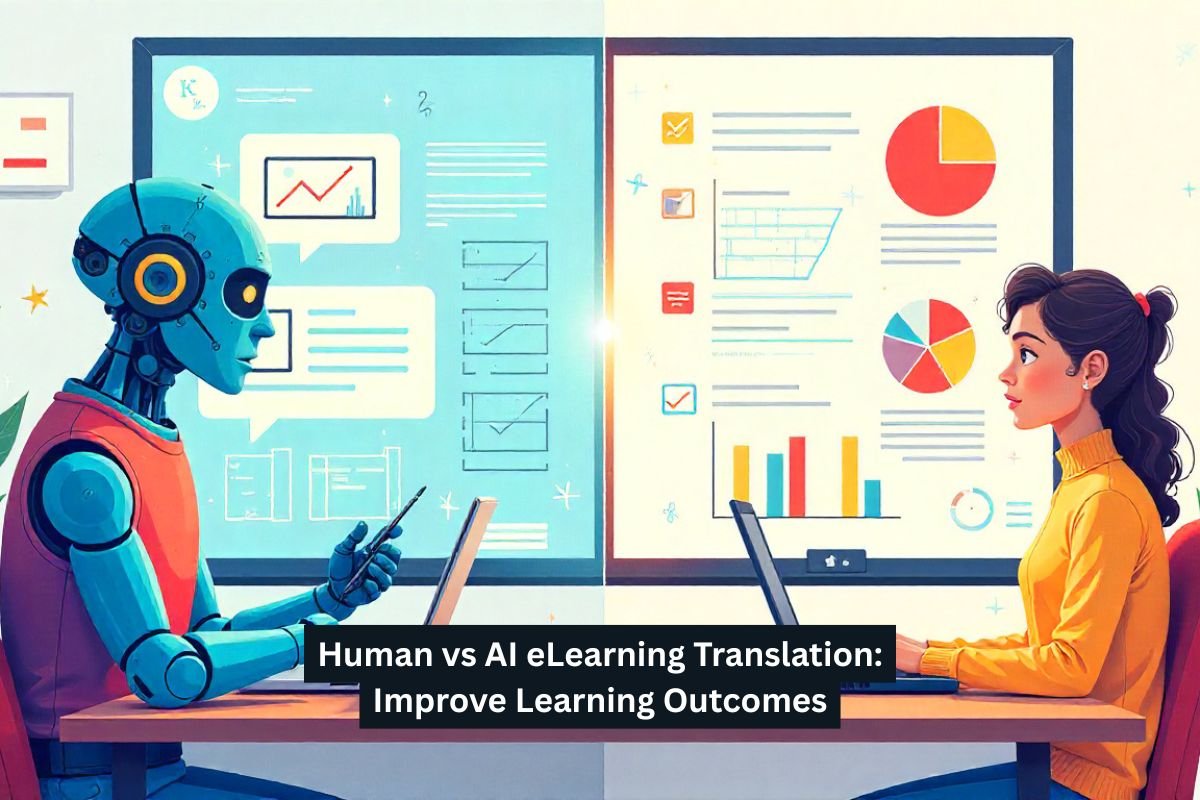
Human vs AI Translation in eLearning: What Actually Improves Learning Outcomes?
January 2, 2026
info@ananenterprises.com
Introduction
Global eLearning is growing fast—but learning outcomes don’t scale automatically with content volume.
When courses cross borders, translation quality becomes a learning variable rather than a backend task.
The real question isn’t “Is AI translation faster?”
It’s “Does it help learners understand, retain, and apply knowledge?”
This guide breaks down Human vs AI translation in eLearning, focusing on what truly matters: learning outcomes.
Translation Isn’t Just Language. It’s Part of Learning Design.
In eLearning, translation affects:
- How easily learners understand concepts
- How accurately they complete assessments
- How confidently they apply knowledge on the job
- Whether training meets compliance and safety requirements
Poor translation doesn’t just confuse learners—it undermines the entire training program.
First, What Do “Learning Outcomes” Actually Mean in eLearning?
Learning outcomes are measurable results that indicate whether training was practical.
Core eLearning learning outcomes include:
- Knowledge retention – Can learners remember the content?
- Skill application – Can they use it correctly?
- Assessment accuracy – Do quiz results reflect real understanding?
- Completion rates – Do learners finish the course?
- Compliance understanding – Do they follow rules correctly?
Language clarity directly affects every one of these outcomes.
How AI Translation Works in eLearning (And Where It Helps)
AI translation uses Neural Machine Translation (NMT) or LLM-based engines to convert content at scale.
Where AI translation performs well:
- High-volume text
- Repetitive instructional content
- Internal drafts
- Time-sensitive rollouts
- Low-risk knowledge modules
Typical AI use cases in eLearning:
- Auto-translating LMS text
- Subtitle generation
- First-pass translation for review
- Microlearning snippets
AI is fast, scalable, and cost-efficient—but speed is not the same as learning effectiveness.
Where AI Translation Starts Hurting Learning Outcomes
AI struggles with instructional intent, not just language.
Common AI translation risks in eLearning:
- Literal translations that increase cognitive load
- Inconsistent terminology across modules
- Awkward phrasing that slows comprehension
- Misinterpreted quiz questions
- Incorrect scenario logic
- Loss of tone and learner motivation
Result: Learners may finish the course, but learn less.
What Human Translation Brings to eLearning (That AI Can’t)
Human translators don’t just translate words—they interpret learning intent.
Human-led eLearning translation focuses on:
- Learner reading level
- Instructional clarity
- Cultural learning preferences
- Pedagogical flow
- Terminology consistency
Human translators understand why a sentence exists, not just what it says.
How to Adapt Your Website for Global Users
Human vs AI Translation: Side-by-Side Impact on Learning
| Learning Factor | AI Translation | Human Translation |
|---|---|---|
| Clarity | Grammatically correct but unnatural | Clear, learner-friendly |
| Context | Often lost across modules | Preserved across lessons |
| Engagement | Neutral, robotic | Natural, motivating |
| Knowledge Retention | Lower due to phrasing | Higher due to fluency |
| Assessments | Risk of ambiguity | Preserves intent & logic |
| Compliance Training | High risk | Low risk |
Bottom line: AI translates content. Humans translate understanding.
How Translation Quality Impacts Real Learning Metrics
1. Course Completion Rates
Learners drop off when language feels unnatural or confusing.
Human translation reduces friction and keeps learners moving.
2. Assessment Scores
Poorly translated questions lead to:
- Wrong answers
- False negatives
- Invalid results
Human translation ensures assessment accuracy.
3. Compliance & Safety Outcomes
In regulated industries, misinterpretation can lead to:
- Legal exposure
- Safety incidents
- Audit failures
Human translation minimises risk.
4. Learner Satisfaction & Trust
Learners trust training more when it sounds local and natural.
When AI Translation Is Enough for eLearning
AI can work when:
- Content is informational, not instructional
- There are no graded assessments
- Risk of misunderstanding is low
- Content is for internal reference
- Human review is planned later
AI works best as a support tool—not the final authority.
When Human Translation Is Non-Negotiable
Human translation is essential for:
- Compliance training
- Healthcare and safety modules
- Legal and ethics training
- Certification programs
- Scenario-based learning
- Customer-facing courses
If misunderstanding has consequences, human translation is not optional.
The Smart Middle Ground: AI + Human Hybrid Translation
Most successful eLearning programs use a hybrid approach.
How hybrid workflows improve outcomes:
- AI handles speed and scale
- Humans ensure clarity, accuracy, and pedagogy
- QA processes catch learning-impacting errors
- Glossaries ensure consistency across courses
Benefits of hybrid eLearning translation:
- Faster go-to-market
- Better learner experience
- Scalable multilingual training
- Lower risk without sacrificing speed
How to Choose the Right Translation Approach for Your Course
Ask these questions before deciding:
- Is this training compliance-critical?
- Are learners being assessed?
- What happens if content is misunderstood?
- Is this internal or customer-facing?
- Does learner trust matter?
Quick decision guide:
| Content Type | Best Approach |
|---|---|
| Internal knowledge | AI + review |
| Sales enablement | Hybrid |
| Compliance training | Human |
| Healthcare training | Human |
| Microlearning | Hybrid |
| Certification courses | Human |
The Real Takeaway: Learning Outcomes Don’t Improve by Accident
AI translation helps you move fast.
Human translation helps learners succeed.
In eLearning, translation is part of instructional design—and learning outcomes depend on it.