
- About
- Services
- Translation
- Transcription
- Subtitling
- Interpretation
- Languages
- Blog
- Contact Us
- Request a Quote

Simplified vs Traditional Chinese: Which One Does Your Business Actually Need?
April 21, 2026
info@ananenterprises.com
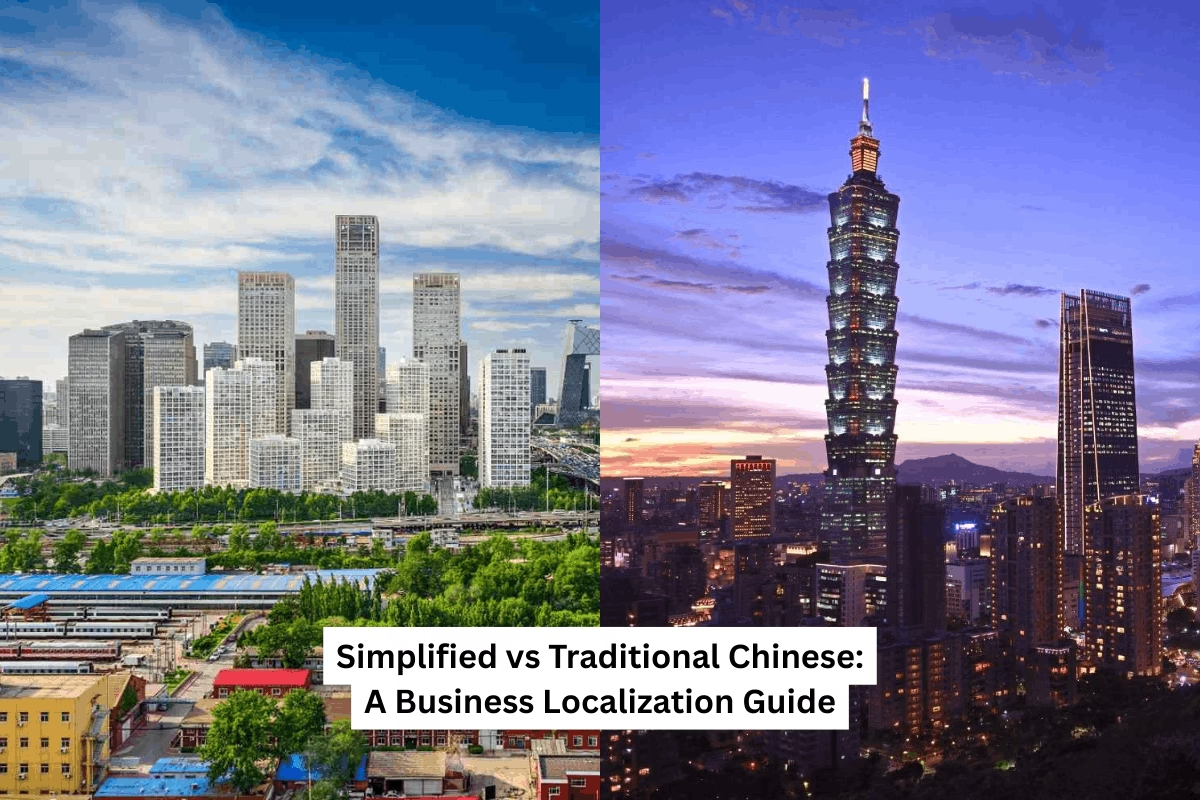
One Wrong Choice = Lost Market
Choosing between Simplified and Traditional Chinese affects how your brand comes across in different markets. The script you use shapes how familiar and trustworthy your content feels. If it doesn’t match what your audience expects, your message can feel off or out of place.
For businesses entering Chinese-speaking markets, this is one of the most common and overlooked localization mistakes. When you choose the right script, your content feels natural to the audience, which helps improve engagement, build trust, and drive better results.
What Is Simplified vs Traditional Chinese (In Plain English)?
At a basic level, both Simplified and Traditional Chinese represent the same language. The difference lies in how the characters are written.
- Simplified Chinese uses fewer strokes and simpler forms of characters
- Traditional Chinese retains the original, more complex character structures
It’s not about translating into two languages; it’s about using the script your audience actually reads.
Where Each Script Is Used (And Why It Matters)
| Region | Preferred Script | Key Insight |
|---|---|---|
| Mainland China | Simplified Chinese | Largest market, strict localization expectations |
| Singapore | Simplified Chinese | Business-friendly, multilingual audience |
| Taiwan | Traditional Chinese | Strong cultural preference for traditional script |
| Hong Kong | Traditional Chinese | Formal, Cantonese-influenced content |
| Macau | Traditional Chinese | Similar to Hong Kong in usage |
Why this matters:
If content feels familiar, people are more likely to trust it and interact with it. Even when both are readable, most users prefer their usual script.
Why These Two Systems Exist
The difference between them comes from history and government decisions.
- Simplified Chinese was introduced in the People’s Republic of China to improve literacy by reducing character complexity
- Traditional Chinese has been preserved in regions like Taiwan and Hong Kong to maintain cultural and linguistic heritage
The script you choose reflects how much you respect the local audience.
Key Differences That Actually Affect Your Business
Many assume the only difference is visual—but in practice, it goes deeper.
1. Vocabulary Differences
Certain words and phrases differ across regions. A direct conversion between scripts may not always reflect local usage.
2. Tone and Communication Style
- Mainland China content often leans more directly and modern
- Taiwan and Hong Kong may favor a slightly more formal or nuanced tone
3. UX and Design Considerations
- Character density affects layout and spacing
- UI elements may need resizing or restructuring
4. Platform Behavior
- Users in Mainland China rely heavily on platforms tied to Baidu
- Other regions follow different browsing and content patterns
The #1 Mistake Businesses Make
“Let’s Just Translate It Once”
It’s a common assumption that often turns out to be expensive.
Many businesses:
- Translate content into one Chinese script
- Use it across all regions
- Expect consistent performance
What actually happens:
- Lower engagement rates
- Reduced credibility
- Missed sales opportunities
Chinese-speaking markets are not one unified audience—they are distinct, localized markets.
How to Choose the Right Chinese Script for Your Business
Instead of guessing, use a structured approach.
Step 1: Identify Your Target Market
- Selling in Mainland China → Use Simplified Chinese
- Targeting Taiwan or Hong Kong → Use Traditional Chinese
Step 2: Understand Your Audience
- B2B vs B2C communication styles
- Industry-specific tone expectations
Step 3: Consider Your Content Type
- Websites and apps
- Marketing campaigns
- Legal and compliance documents
Step 4: Plan for Scalability
If expansion is likely, build systems that can support both scripts from the start.
Do You Need Both Simplified and Traditional Chinese?
For many growing businesses, the answer is yes—but not immediately.
You may need both if:
- You’re expanding across multiple Chinese-speaking regions
- You’re running region-specific campaigns
- You want a consistent brand presence across markets
Smart approach:
Start with your primary market, then expand with localized adaptations rather than direct conversions.
Chinese Localization ≠ Translation
Translation changes the words, localization changes the meaning.
True Chinese localization includes:
- Script selection (Simplified vs Traditional)
- Cultural tone and messaging
- Region-specific vocabulary
- Platform and UX adjustments
Without localization, even a perfectly translated sentence can feel out of place.
SEO Insight: Why Script Choice Impacts Visibility
Search behavior differs across regions, and so does indexing.
- Search engines like Baidu prioritize Simplified Chinese content
- Users in Taiwan and Hong Kong search using Traditional Chinese
Impact on SEO:
- Wrong script = poor keyword alignment
- Lower rankings in local search results
- Reduced organic traffic
When Machine Translation Falls Short
Machine translation tools often struggle with Chinese due to:
- Script inconsistencies
- Lack of cultural understanding
- Incorrect tone adaptation
It may be technically correct, but it still misses the real meaning.
Quick Decision Checklist
If you’re still unsure, use this:
- Who is your primary audience?
- Where are they located?
- Which platforms are they using?
- Do you plan to expand into other regions?
Your answers will usually point clearly to the right script.
Final Takeaway
Choosing between Simplified and Traditional Chinese is really about relevance to your audience, not just language. The right script helps your content feel familiar, which builds trust, improves engagement, and increases conversions. The wrong choice does the opposite; it quietly reduces trust, lowers engagement, and leads to missed opportunities over time.